South Carolina planting dates for raised beds depend on your county’s Clemson planting region, the crop and season, and the actual soil and weather—not the date alone. Clemson HGIC 1256 puts Richland and Lexington Counties in the Coastal Plain group, and nearby Fairfield, Kershaw, and Newberry in the Piedmont group; those planting columns are not the same. A date on a chart is a planning window, not permission to put tomatoes into a cold, soggy bed. Good drainage, a soil test, reachable beds, and dependable watering matter just as much as the date.
Howdy — I’m Pap Steve. I garden in raised beds on our homestead near Blythewood, South Carolina, I buy my own gear, and the advice below comes from Clemson Extension unless I label it as a homestead note. This guide brings the practical decisions together: what to plant, when to plant it, and how to keep a raised bed working. No garden magic, just a useful place to start.
By Pap Steve • Gardening reference • Last reviewed November 10, 2026. Planting windows and sources last checked November 7, 2026. Planting windows are regional guidance, not a forecast for a particular year.

On this page
- Which planting region should I use?
- When should I plant vegetables in South Carolina?
- Do the dates mean it is safe to plant?
- Should I sow seeds or buy transplants?
- Is November too late for garlic?
- How do I plan repeat harvests?
- Where should raised beds go?
- Will a raised bed fix poor drainage?
- Do I need a soil test?
- How much compost should I add?
- How should I water raised beds?
- What mulch should I use?
- What should I check before planting tomatoes?
- Quick answers
- More from the garden
- Sources and scope
Which Clemson planting region should I use near Blythewood?
Use the county where the garden actually sits, not “Midlands” or a mailing city by itself. Clemson HGIC 1256 puts Richland and Lexington in the Coastal Plain group. Fairfield, Kershaw, and Newberry are in its Piedmont group. Those nearby counties do not all share the same planting column.
Check your county on your property records or county GIS map, then match it to Clemson’s county list. For a garden near a county boundary, ask your county Extension office which local timing fits your site. You do not need to share your street address here. “Coastal Plain” is Clemson’s chart label; it does not mean every reader lives at the beach.
The table includes both regions so you can compare them without guessing. Other South Carolina counties should use the complete county list in the linked factsheet. Do not extend these dates into another state without that state’s Extension guidance.
When should I plant vegetables in South Carolina?
Use the outdoor planting window for your county’s Clemson region and the crop you want to grow. The dates below are from Table 1 of Clemson HGIC 1256, not indoor seed-starting dates. “Transplants” identifies the crops marked that way in Clemson’s chart. Other rows are not automatically a recommendation to transplant. “Not recommended” preserves the source’s wording; it does not mean a protected-growing experiment is impossible.
| Crop | Coastal Plain spring | Coastal Plain fall | Piedmont spring | Piedmont fall |
|---|---|---|---|---|
| Snap beans | Apr 1–Jun 1 | Aug 1–Sep 1 | Apr 15–Jul 1 | Jul 20–Aug 1 |
| Beets | Feb 15–Mar 31 | Aug 15–Sep 30 | Mar 15–May 31 | Jul 15–Aug 31 |
| Broccoli (transplants) | Mar 1–Apr 10 | Sep 1–Sep 30 | Mar 20–Apr 30 | Aug 15–Sep 15 |
| Cabbage (transplants) | Feb 1–Mar 31 | Aug 15–Sep 30 | Mar 15–Apr 30 | Jul 15–Aug 31 |
| Carrots | Feb 1–Mar 15 | Sep 1–Sep 15 | Feb 15–Mar 31 | Aug 1–Sep 15 |
| Collards | Feb 1–Jun 15 | Aug 1–Oct 30 | Mar 15–Jun 30 | Aug 1–Sep 30 |
| Cucumber | Mar 15–May 15 | Aug 1–Aug 30 | Apr 15–Jun 5 | Aug 1–Sep 30 |
| Garlic | Not recommended | Oct 1–Nov 30 | Not recommended | Aug 15–Oct 15 |
| Kale | Feb 1–Jun 15 | Aug 1–Oct 30 | Mar 15–Jun 30 | Aug 1–Sep 30 |
| Lettuce | Feb 1–Apr 15 | Sep 5–Nov 1 | Mar 1–May 15 | Not recommended |
| Okra | May 1–Jun 30 | Not recommended | May 15–Jul 15 | Not recommended |
| Pepper (transplants) | Apr 1–May 15 | Jul 10–Aug 10 | May 1–Jun 30 | Not recommended |
| Irish potatoes | Feb 1–Mar 31 | Not recommended | Mar 15–Apr 30 | Not recommended |
| Spinach | Feb 1–Apr 1 | Aug 15–Oct 15 | Mar 15–Apr 15 | Aug 1–Sep 30 |
| Summer squash | Mar 15–Jul 31 | Aug 1–Aug 31 | Apr 15–Jul 31 | Jul 15–Aug 15 |
| Tomato (transplants) | Mar 1–Apr 30 | Jul 1–Jul 31 | May 1–Jun 30 | Not recommended |
Source difference worth knowing: HGIC 1256 lists Coastal Plain fall tomatoes through July 31, as shown above. The crop-specific Clemson HGIC 1323 lists July 1–15. For fall tomato planning, use that narrower crop-specific window or ask Extension rather than assuming the later date works in your bed. Check crop-specific advice for other late-edge plantings, too.
Do the chart dates mean it is safe to plant today?
No. Match the window to crop hardiness, soil conditions, and the local forecast. Clemson distinguishes cool-season crops, which struggle in summer heat, from warm-season crops, which freezing temperatures can injure or kill. Raised beds warm faster in spring, but that does not remove freeze risk. Avoid working compacted soil while it is wet; Clemson HGIC 1257 advises waiting until it is dry to loosen it.
For supporting context, the Old Farmer’s Almanac Columbia calendar lists average last spring frost as March 24 and average first fall frost as November 9 at the COLUMBIA UNIV OF SC station. Those are historical averages, not a Blythewood forecast or a promise for your yard. Check the current forecast and the crop’s soil-temperature needs before sowing.
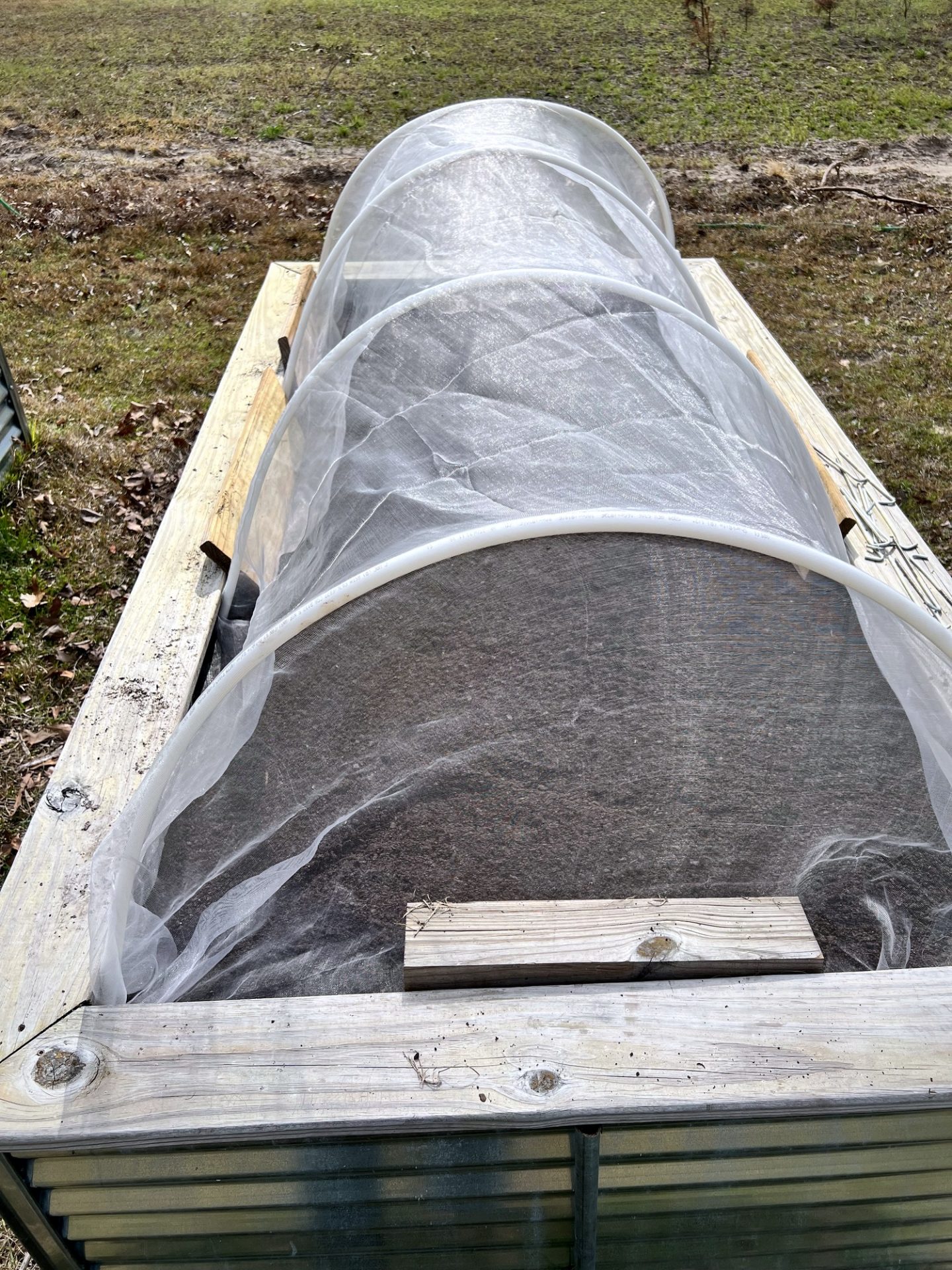
The USDA hardiness map describes winter cold for perennial plants; it is not a vegetable date calculator. The Old Farmer’s Almanac is a different publication from Farmers’ Almanac. Moon-favorable dates are not the evidence-based foundation here. For cold-weather protection ideas, see my row-cover and hoop post; no cover promises survival in every freeze.
Should I direct-sow seeds or buy transplants?
Use the method suited to the crop, then work backward from its outdoor window. Clemson HGIC 1259 says beans and carrots should go directly into the garden; they do not transplant well. Broccoli, cabbage, kale, lettuce, tomatoes, and peppers transplant readily. Direct sowing means planting seed in the bed where it will grow, not starting it indoors on the same date.
If growing your own transplants, use a well-drained seed-starting mix, adequate light, and gradual outdoor conditioning. Clemson estimates about 6–8 weeks from sowing to transplanting for tomatoes and 8–10 weeks for peppers. Those are planning estimates, not a guarantee seedlings will be ready. Purchased starts can save that indoor work. Choose stocky plants rather than tall, weak ones, and harden them off before full garden exposure.
Is November too late to plant garlic in South Carolina?
Not necessarily in the Coastal Plain; it is later than Clemson’s Piedmont window. HGIC 1256 gives Coastal Plain garlic planting as October 1–November 30, versus August 15–October 15 in the Piedmont. It does not recommend spring planting in either region. That makes your actual county important before copying a neighbor’s November plan.
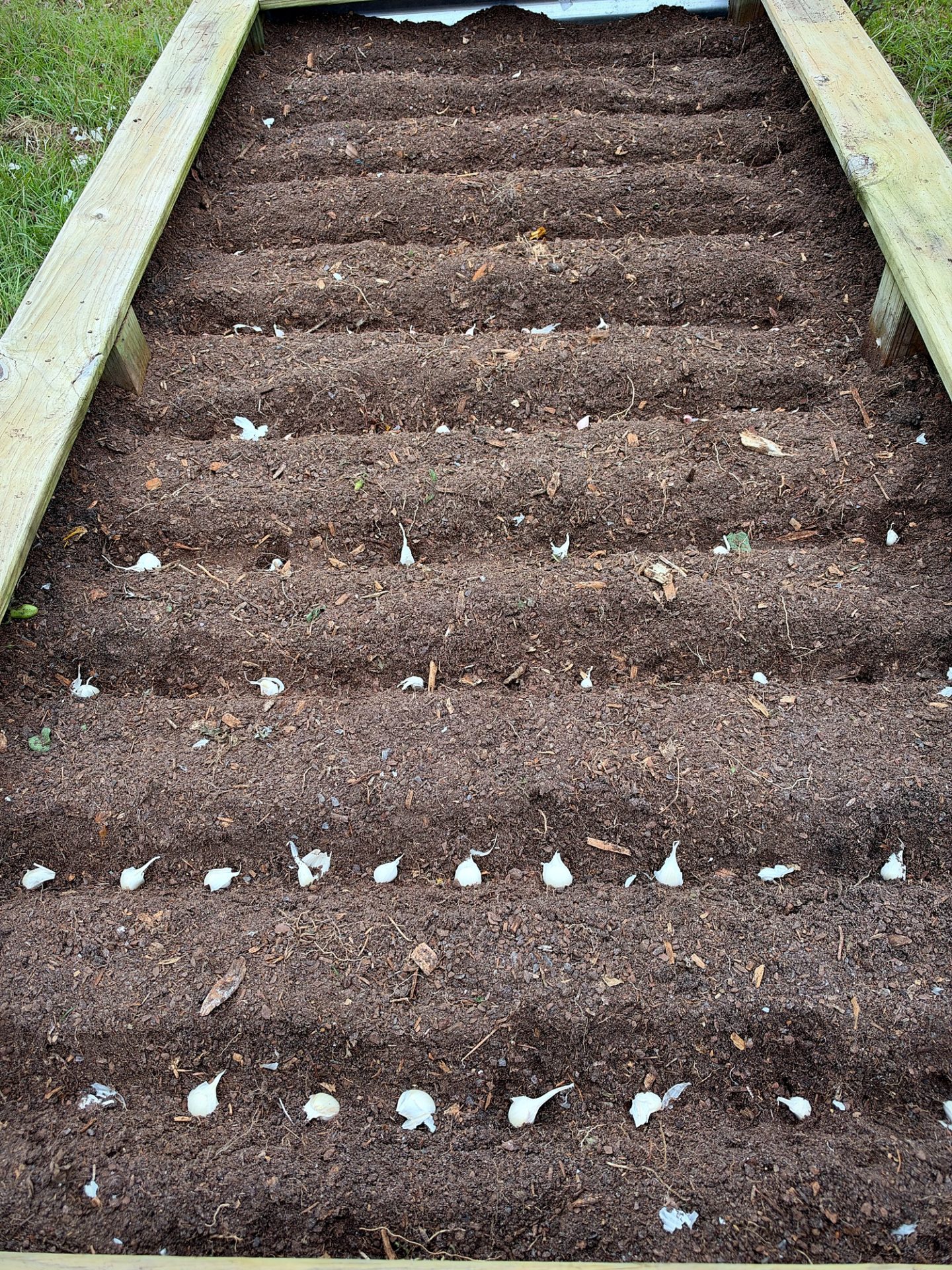
Reserve garlic space on the bed map instead of treating it as a quick gap-filler. It occupies the bed beyond the fall greens season, so plan the next crop around it. Choose planting stock and varieties suited to the region, and follow the detailed planting guidance linked in my South Carolina garlic guide. Homestead note: I planted 10 garlic rows in fall 2026. That describes my planting, not a yield forecast or a suggested amount for your household.
How do I plan repeat harvests without overplanting?
Map what your household eats, when space opens, and what can mature in the remaining season. Clemson recommends separate spring, summer, and fall plans. Group crops with similar growing periods, and leave space for a replacement after an early crop finishes. Put tall or trellised plants on the north side so they do not shade shorter crops unnecessarily.
For lettuce and spinach, Clemson flags sequential planting to extend harvest. Sow smaller batches within the appropriate window instead of filling every available spot at once. Check variety maturity information and whether it counts from seed or transplant. A fall window does not erase the need to finish before damaging cold. Rotate vegetables and related crops where possible rather than repeating the same family in the same bed each year. My fall-greens post adds the homestead perspective.
Where should raised beds go, and how wide should they be?
Choose sun, water access, and comfortable reach before choosing how many beds to build. Clemson HGIC 1257 recommends at least six hours of direct sunlight daily and beds about 3–4 feet wide when accessible from both sides. If a bed backs against a fence, make it narrow enough to reach from the accessible side. The practical rule is simple: tend the center without walking on the growing soil.
Lay out the footprint and paths before building. Make sure you can bring in amendments, carry a watering can, and harvest without squeezing through foliage. Keep the garden convenient to check regularly. Trees and shrubs compete for water and nutrients as well as casting shade. A small bed you can keep weeded and watered is more useful than a big layout that becomes another chore you dread.
Will a raised bed fix poor drainage or compacted soil?
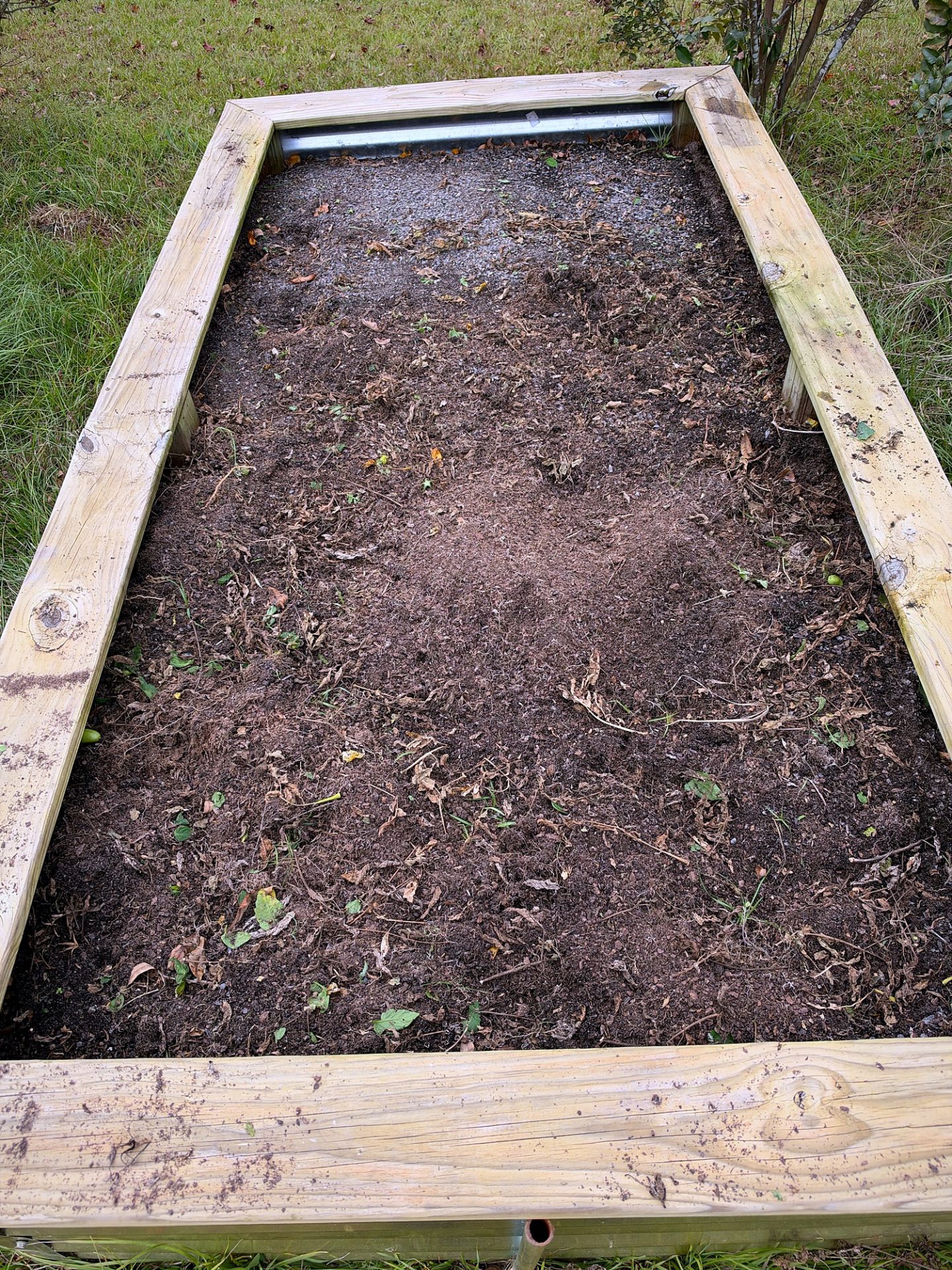
It can improve the growing area, but the site and the soil underneath still matter. Clemson recommends a well-drained location even for raised beds. Look at the intended spot after rain before committing to it. If water stands there or flows through it, address that drainage problem or choose another location rather than assuming a taller enclosure solves everything.
For an open-bottom bed over ground soil, follow HGIC 1257’s preparation advice: loosen the existing soil as deeply as practical, waiting for compacted soil to dry first. Add suitable topsoil and organic material as needed. Keep feet and equipment out of the bed afterward so you do not compact it again. If you garden on a hard surface or use a soilless growing medium, ask Extension for setup and testing guidance specific to that situation; an ordinary ground-soil recipe does not cover every container.
Do I need a soil test if I bought raised-bed soil?
Yes—buying soil does not tell you its current pH or nutrient balance. Clemson HGIC 1652 explains how testing guides fertilizer and lime instead of guessing. Extra lime or phosphorus can create problems where the soil already has enough. Yellow leaves alone are not a reliable shopping list for amendments.
For a soil-based vegetable bed, Clemson calls for a composite of 8–10 or more cores, sampled to a depth of six inches. Mix them in a clean plastic bucket. Sample beds with different fill, fertilizing history, or problem areas separately rather than averaging away the difference. Tell the lab what you plan to grow. Clemson recommends annual sampling; allow time before planting for any needed adjustment. Soilless mixes require a different analysis, so confirm the appropriate test with Extension before submitting. Follow your report’s recommendations, scaled to the actual bed area—not a universal scoop-per-bed recipe.
How much compost should go into a raised bed?
Compost is an amendment, not a substitute for the whole root zone. HGIC 1257 describes good topsoil with compost making up about 10–20% of the total soil-medium volume. That recommendation is for a soil-based bed, not a mandate to rebuild every existing mix. Clemson warns that both too little organic matter and too much composted material can cause problems.
For an existing bed, consider what is already there, how it drains, and what the soil test says before adding more. Organic material decomposes, so some replenishment makes sense over time. That does not justify dumping the same large amount in every season. Calculate fill needs from the bed’s actual inside dimensions, and ask the supplier what the material contains. Keep compost addition, fertilizer choice, and lime application as separate decisions. “It’s natural” does not mean “more is always better.”
How should I water raised beds in South Carolina heat?
Water the root zone and check the soil, rather than trusting a fixed daily timer. Raised beds dry faster than in-ground beds. Clemson HGIC 1260 favors drip irrigation for water conservation and describes soaker hoses as another useful option. With a hand-held hose, direct a gentle stream toward the base rather than repeatedly wetting the leaves.
Plan irrigation before foliage fills the bed. Check that water reaches the planted area, not just the nearest emitter, and adjust for rainfall and changing conditions. A timer is helpful, but it cannot notice a clogged line for you. Clemson identifies establishment after planting or transplanting, and fruit or storage-organ development, as especially sensitive periods for water shortage. If using overhead irrigation, water early in the morning to reduce disease risk. There is no single runtime that fits every bed, soil mix, emitter, and stretch of weather.

What mulch should I use, and should empty beds stay covered?
Use mulch to conserve moisture and suppress weeds, without smothering young plants or blocking water. Clemson HGIC 1604 identifies straw as useful for vegetable gardens. It cautions against hay because of weed seeds and against grass clippings from herbicide-treated lawns. Weed the bed before covering it; mulch is not a substitute for removing established weeds.
Keep newly sown areas accessible for germination and watering. Check beneath the mulch to make sure water gets through; matted material can repel it. For an unplanted bed, HGIC 1257 recommends a two-inch cover of materials such as pine straw or leaves, or an appropriate cover crop. Choose a cover crop with a plan for ending it before the next planting. A protected resting bed is useful; a bed hidden under an unchecked weed patch is not taking a vacation.

What should I check before planting tomatoes in a raised bed?
Check the planting window, plant quality, support, and variety—not just the picture on the tag. Tomatoes are warm-season plants. Set out hardened transplants when conditions are suitable, and use the tomato-specific fall-window caution above. Clemson HGIC 1323 recommends a well-drained site and avoiding places where tomatoes, peppers, eggplant, or potatoes have grown for at least three years to reduce soil-borne disease and nematode problems.
Install an appropriate cage, stake, or trellis early. Support keeps plants and fruit off the ground and improves airflow. Look at disease-resistance information when choosing varieties; an heirloom label is not disease protection. Homestead note: I have grown San Marzano tomatoes. That is experience with a variety, not proof that it is best for every South Carolina bed. If rotation space is limited, ask Extension about your options rather than assuming fresh compost resets a bed’s disease history.

Quick answers
When should I plant a fall garden in South Carolina?
Use your county’s Clemson region and the crop’s fall window—not a single statewide date. In the Coastal Plain, many cool-season crops such as snap beans, collards, and kale can be planted beginning August 1; spinach and beets beginning August 15; lettuce from September 5 through November 1; and garlic from October 1 through November 30. In the Piedmont, several fall windows start earlier: snap beans July 20–August 1; beets, cabbage, and summer squash as early as July 15; collards and kale August 1–September 30; and garlic August 15–October 15. Clemson does not recommend fall lettuce, peppers, or tomatoes in the Piedmont, or fall okra or Irish potatoes in either region. These are outdoor planning windows from Clemson HGIC 1256, not a forecast. Check soil and weather before you plant, and use the table above for the full selected-crop list, including the narrower crop-specific note for fall tomatoes.
When should I plant garlic in South Carolina?
Plant garlic in the fall, not the spring. Clemson HGIC 1256 lists Coastal Plain planting as October 1–November 30 and Piedmont planting as August 15–October 15. Spring planting is not recommended in either region. November can still fit the Coastal Plain window; it is later than the Piedmont window, so use your actual county before copying a neighbor’s plan. My South Carolina garlic guide has the detailed planting notes.
More from the garden
- When to Plant Garlic in South Carolina — the garlic-specific guide.
- Fall Greens in Raised Beds — cool-season garden notes.
- Row Covers and Hoops — cold-weather protection ideas.
- How to Grow Swiss Chard — the existing crop guide.
- Browse the Gardening archive — more garden posts.
- Canning Questions Answered — safe home-canning basics, kept as a separate topic.
Sources and scope
Clemson Extension supplies the planting and growing guidance; my labeled homestead notes describe only my own documented planting. I am a home gardener, not Extension staff. Check the linked sources for updates and ask your county Extension office about conditions the regional charts cannot settle.
- Clemson HGIC 1256 — Planning a Garden; regional county lists and planting windows. Revised February 12, 2021.
- Clemson HGIC 1257 — Raised Beds; layout, drainage, soil mix, and maintenance. Revised August 1, 2017.
- Clemson HGIC 1652 — Soil Testing; sampling and soil-based amendment decisions.
- Clemson HGIC 1259 — Starting Seeds Indoors; transplant suitability and preparation.
- Clemson HGIC 1260 — Watering the Vegetable Garden; root-zone irrigation and sensitive growth stages.
- Clemson HGIC 1604 — Mulch; materials, benefits, and cautions.
- Clemson HGIC 1323 — Tomato; crop-specific dates, support, rotation, and variety selection. Revised March 2, 2022.
- Old Farmer’s Almanac, Columbia — station frost averages only.
- USDA Plant Hardiness Zone Map — perennial winter-hardiness context.
 English